How to Turn Oral History into Family Stories
Episode #003 – Interview with Stacy Hawks of Dividing Ridge Genealogy
Stacy Hawks is a North Carolina Society of Historians award-winning author for Excellence, an NC Literary Map author, and founder of Dividing Ridge Genealogy.
Catch the full episode on Spotify — uncover family history research methods and inspiring genealogy discoveries.
Here’s a link to the book Stacy mentioned in the podcast:
Here’s a link to the website Stacy mentioned in the podcast:
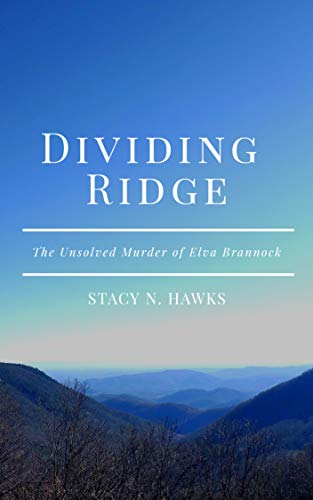
Dividing Ridge: The Unsolved Murder of Elva Brannock
By: Stacy Hawks
Dividing Ridge is based on a true story of an unsolved crime that took place along the Blue Ridge Parkway in Alleghany, N.C. in 1937. After a young woman goes missing on her way to school, a community is left on edge. With news spreading quickly of her disappearance and gossip swirling, it is up to local law enforcement to restore a sense of safety and one determined Sheriff to bring justice to her family.
Here’s an excerpt from Chapter 6:
It was cold. So cold she could see her breath form a small cloud between the raindrops as they fell before her. The wet grass and slightly soggy path to the schoolhouse covered her shoes with a mixture of morning dew and mud. The books in her arms became heavy as she continued to walk. Her thoughts turned to her lessons and then to her mother’s voice telling her to be careful. Fog continued to rise and settle along the path as she saw the familiar faces of two Parkway workers waiting for their ride. Slowing her pace just a bit she turned her head to the right, towards the woods, an unfamiliar sound catching her attention. Elva knew the construction crews were out working on the new Parkway Project. Thus she had grown accustomed to hearing them crank their trucks, rustle through the brush and chop trees on her way to and from school. She paused again, feeling as though she were being watched. Upon second glance Elva caught a swift movement out of the corner of her eye. As she was swept away in the morning mist, the fog on the road and her footprints became the only proof that she had ever been there…
Connect with Stacy:
Dividing Ridge Genealogy
Connect with Storied:
Follow @storied_social on Instagram and Twitter.
Like storied_social on Facebook.
Subscribe to @storied_social on YouTube.
Interested in being on our show?
Love family history and telling stories? You could be the next guest on The Family Treehouse! Email our host, Heather Haunert, for more information at [email protected].
Where can I get Stacy's books?
Stacy’s books are available on Amazon. Click HERE to go to her author page.
Does Stacy have a website?
Yes! Stacy’s website contains information about Dividing Ridge genealogy services, a genealogy spotlight, and blog. The guest posts are fantastic! You can find her website HERE.
Transcript:
Host (Heather Haunert):
And welcome to The Family Treehouse, a podcast series brought to you by Storied, where I chat with people that have a passion for genealogy, storytelling, or both. I’m your host, Heather Haunert, and today I am very excited to have our guest with us — Stacy Hawks of Dividing Ridge Genealogy.
She’s also an award-winning author, which is super exciting for me. So welcome, Stacy.
Guest (Stacy Hawks):
Thank you so much for having me, Heather. It’s a pleasure to be here.
Background
Host:
Super excited to chat today. Why don’t you start by telling us a little bit about your background and how you got started in the field of family history and storytelling/writing — because you kind of run that gamut for us today.
Guest:
Sure. As you mentioned, I am a North Carolina Society of Historians award-winning author. I also have a Bachelor of Arts in History from Brevard College in Brevard, North Carolina, and I hold an M.Ed. from Liberty University in Teaching and Learning.
I basically grew up here in Appalachia, where we’re introduced to a world of oral family history at a very young age. I grew up hearing stories about our family from my grandparents and parents, learning more about the people who make up our family tree as the years went on.
I came to really appreciate the way these stories are passed down about loved ones we didn’t get to meet, and how we rely on their memory to keep them alive. That’s how I got started in loving genealogy and history.
Host:
Yeah, that’s great. To me, Appalachia is synonymous with oral history. You kind of hit the nail on the head there.
Importance of Storytelling
Host:
Why do you think storytelling is such an important part of family history — going beyond just the records and the names and dates?
Guest:
Absolutely. I think the importance of storytelling is that our ancestors had lives — they were living, breathing individuals with goals, families, worries, ambitions, dreams. If they were moving from one country to the next or migrating for whatever reason, storytelling breathes life into that time period and allows us to step back and reflect on it.
One of my favorite writers, Pearl S. Buck, said, “One faces the future with one’s past.” That’s so true. We cannot move forward without looking back and taking something from our history, learning from the individuals who got us to this point — not just individually, but as a nation.
Storytelling weaves the fabric of history not just for families, but for communities and cultures. Within stories, we learn things like how to make the best cornbread, or how to conduct ourselves in mourning — in Appalachia, there’s a lot of tradition behind wakes and mourning rituals. There’s art, old wives’ tales, sayings, and recipes that carry so much history.
Family Roots in the Area
Host:
How far back does your family go in the area?
Guest:
Pretty far back. My grandfather’s side — his great-grandfather was a Revolutionary War soldier who lived just across the line in Grayson County, Virginia. My grandmother’s people also came from this area. We have Scots-Irish, German, English, and even Native American roots.
Host:
I think people outside the Southeast can’t really comprehend how much history is all around you here every day. It blows me away how far back it goes.
How to Write a Story
Host:
If you want to write a story about an ancestor or something that’s been passed down, how do you go about it?
Guest:
I’m a planner. Some people “pants” it — they pick a topic and just run with it. But for genealogy, you want to organize your thoughts and structure the story.
Decide on the time frame — are you covering a short period, like the Civil War years, or an entire lifetime? Start with the basics: where they were born, when they died, who their family was. Look for documents — did they serve in the military? Did they live through the influenza epidemic?
Structure is key, and make sure what you write is as accurate as possible. And if you don’t know — ask, or at least research online.
Story Length
Host:
Do you tend to write shorter or longer stories?
Guest:
I usually write long stories because I’m a novelist, but for genealogy, I have to trim it down and stick to the point. Sometimes that can be challenging, because you can get really taken with an ancestor — they start to feel like a character you deeply connect with.
Host:
Yes! Those are my favorite, when I get carried away and go down the rabbit hole.
Guest:
[laughs] Oh, I do that a lot too.
Resources
Host:
Do you have any resources or tools you recommend for people wanting to start researching and writing their family history?
Guest:
Sure. Most people know Ancestry, Newspapers.com, NewspaperArchive, and now Storied — which is an amazing platform.
Also, your local Register of Deeds office is great. In North Carolina, all 100 counties have “Heritage Books” — black books with the county seal. You can find them in libraries. They include detailed histories, agricultural info, manufacturing notes, and often family stories submitted by residents.
And don’t overlook photos and heirlooms — they’re worth a thousand words and can inspire stories.
Accuracy
Host:
How do you balance accuracy with writing a compelling story?
Guest:
Accuracy is 100% key. When I wrote my first book, Dividing Ridge, I built detailed timelines and researched every detail — down to the cars, shoes, and cigarette brands of the era.
I even built family trees for my main characters to understand all the players. That level of research paid off — the granddaughter of my main character told me I had captured him perfectly, even though I never met him.
Time Investment
Host:
I’ve heard it takes as much time — if not more — to research a historical novel as to write it. True?
Guest:
Absolutely. Dividing Ridge took two years of research, one year of writing/editing, and then I let it sit for ten years before publishing in 2019.
Favorite Family Story
Host:
What’s your favorite family story?
Guest:
Right now, it’s about my mother’s great-grandmother. Everyone called her “Jane” for years, but I could never find a “Jane Dillard” in records. Eventually, on Find a Grave, I discovered her real name was Laura Ellen Dillard. “Jane” was just a nickname. My mom was shocked — she never knew!
It’s a great reminder that people can go by very different names in life.
Tips & Advice
Host:
Any final tips for our listeners?
Guest:
Never be afraid to ask for help. Visit your local historical or genealogy society, your library, or reach out online — there are so many willing to help.
One book I recommend is The Genealogy Planning Research Cycle by Philip Failor, available on Amazon and at your-lineage.com. It’s simple, easy to follow, and also comes in ebook format.
Host:
Great tips! I’ll link to your books and resources when we launch the podcast. Thank you, Stacy — I so appreciate your expertise and passion.
Guest:
Thank you, Heather. I hope everyone finds something here they love.
Host:
Until next time, friends — embrace the power of your family’s untold tales. Start writing your family stories today at Storied.com.
[Music]
And that brings us to the end of this episode of The Family Treehouse, where we celebrate storytelling and preserving family legacies. Your stories matter, and through Storied, they can resonate across time. Keep uncovering your family’s history and keep the spirit of storytelling alive.