Family History Storytelling Secrets
Episode #8 – Interview with Helen Tovey, editor of Family Tree U.K.
Helen Tovey is a passionate advocate for genealogy and family history, leading the way as the editor of Family Tree in the United Kingdom. With an extensive background and a deep-rooted love for uncovering the stories of the past, Helen is dedicated to helping readers explore their family trees, connect with their heritage, and discover the fascinating narratives that shape their lives.
Under Helen’s guidance, Family Tree has become an invaluable resource for enthusiasts, offering expert insights, research tips, and practical guidance to trace one’s ancestry. Her commitment to preserving and celebrating family history has made her a trusted voice in the genealogy community, inspiring countless individuals to embark on their own genealogical journeys.
Catch the full episode on Spotify — uncover family history research methods and inspiring genealogy discoveries.
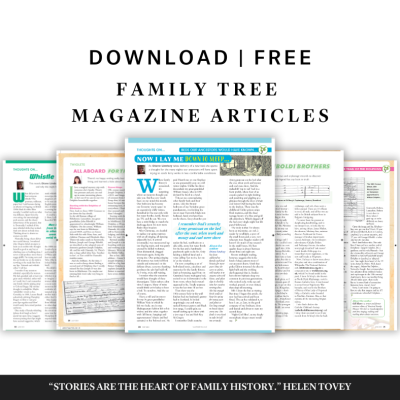
Click the image below to download six articles from Family Tree U.K. for FREE!
Links to people mentioned in the podcast:
Connect with Family Tree:
Like and follow familytreemaguk on Facebook.
Follow familytreemagazine on Instagram.
Follow @familytreemaguk on Twitter.
Like and subscribe to the Family Tree Magazine YouTube channel.
Visit the FamilyTree website.
Connect with Storied:
Follow @storied_social on Instagram and Twitter.
Like and follow storied_social on Facebook.
Subscribe to @storied_social on YouTube.
Interested in being on our show?
Love family history and telling stories? You could be the next guest on The Family Treehouse! Email our host, Heather Haunert, for more information at [email protected].
Transcript:
Host (Heather Haunert):
Hi everyone, and welcome to The Family Treehouse, a podcast series brought to you by Storied, where I chat with people who have a passion for genealogy, storytelling, or both. I’m your host, Heather Haunert, and today I am very excited to have our guest with us: Helen Tovey, editor of Family Tree Magazine in the UK — the longest running genealogical magazine.
Super excited to have you with us today, Helen. Welcome.
Guest (Helen Tovey):
Lovely, thank you, Heather. Super glad to be here.
Host:
Helen, why don’t you start off by telling us a little bit about your background — how you got started in the field of family history and storytelling with the magazine.
Guest:
Sure. Well, I guess I’d always been interested in family history, even though I didn’t really know I was.
As a little child, I used to ask my great-grandmother what it was like to be a child. I was fascinated by the fact that she was born in 1895 — I had this real-life Victorian! I’d ask her all sorts of stories, and the ones that stuck with me were the kinds that would capture a little girl’s mind.
For example, my great-granny used to have her long auburn plaits tied to the back of her chair. I can’t actually remember if it was because she was naughty or to make her sit up straight with good Victorian posture, but either way, I loved those sorts of stories.
I loved studying history at school, then went on to do history at university. It was only when I started working on Family Tree Magazine that I realized I’d actually been doing family history all along. I always thought I was into social history — loving the stories about the community — but it turns out I’d been doing family history my whole life. If you love it, it’s just woven into you, isn’t it?
Host:
Yeah, absolutely agreed. How long have you been working with Family Tree Magazine?
Guest:
A long time now. Back in 2003, I started working for Family Tree Magazine. They had a computer section then — it was still quite new to be using computers for family history.
DNA was just starting, too. Family Tree DNA — the US company — had begun offering consumer tests, but it was still very much a fringe pursuit. Computers, though, were catching on, so I was put in charge of the computer section.
In 2007, I became editor of the whole magazine. So yes, I’ve been doing it a long time — over 20 years now.
Host:
I love what you said about it becoming part of you. You don’t even realize you’re “doing” family history — it just becomes part of who you are.
Guest:
Yes, exactly. You start spotting it everywhere — in history programs, the news, even in everyday conversations.
On Why Storytelling Matters
Host:
Why do you think storytelling is such an important part of family history?
Guest:
I think it’s not just important — it’s at the heart of family history.
You can have a fantastic database, 15,000 ancestors, and all your DNA results, but unless you have stories, it’s just data. We’re not data — we’re human. Stories make us care.
They also make our living relatives care. People who say they’re “not into family history” will perk up when they hear a good family story. Stories help us make sense of our past, treasure it, and want to pass it on.
But they’re also fragile. Unless we make the effort to record them, they’ll be lost. If we’re lucky enough to have stories handed down or to have known older relatives, we have to protect those.
Host:
Yes — I just found a memoir from the 1830s on my dad’s side, and suddenly, that ancestor became real.
On Writing a Family Story
Host:
How do you go about writing a family story?
Guest:
There are different ways. Sometimes it’s sparked by a relative — like my brother wanting to know about our Scottish ancestors after meeting Scottish friends, or someone asking about our great-grandpa who served at Gallipoli.
If your audience isn’t into genealogy, they don’t want research files — they want a story.
For myself, I find prompts essential. A photograph, a notebook, a holiday memento, a piece of inherited furniture — even a photo of it — can be enough.
Start with the prompt. Don’t worry about starting at “the beginning.” Just write. One memory will lead to another, and you’ll often find you have too much to say.
Short is sweet — for both the writer and the reader. A few hundred words can be read in minutes. A few thousand? That might get saved for “later,” which often means never.
On Resources for Beginners
Host:
Do you recommend any resources or tools for someone just starting?
Guest:
If you start writing and realize you don’t have enough information, interview sheets with prepared questions can be very helpful. Use them yourself or give them to relatives to fill out.
For ancestors further back, you’ll need to research — check the major genealogy sites, look up town sizes, distances to workplaces, historical weather — anything that adds context.
Some people and organizations I recommend:
- Natalie Pithers – The Curious Descendants Club (storytelling focus)
- Jill Blanchard – In-depth storytelling courses
- Janet Few – Genealogist, storyteller, novelist, runs workshops
- Mike Sharpe – Helps people write their family history, like a ghostwriter
- Prudence Dwyer – The Creative Family Historian (great free resources)
Balancing Accuracy and Engagement
Host:
How do you balance accuracy with telling a compelling story?
Guest:
Accuracy is non-negotiable. We want the real lived experience of our ancestors, not a generalized version.
However, you don’t have to include every detail. Keep excess facts in your research files or on a blog, and link to them if you want. The story should remain focused and readable.
Helen’s Favorite Story
Host:
Can you share one of your favorite family stories?
Guest:
It’s hard to pick just one! But here’s a favorite:
My mom used to tell me that one of our ancestors invented the roundabout (traffic circle). His name was John Hastings, a saddler in Liverpool.
There were too many accidents outside his shop, so he dug a mound of earth, put a lamp on top, and directed traffic to go around it. The local authorities liked the idea so much they put them all over Liverpool.
During WWII, the metal parts were removed for the war effort, but his idea lived on.
John was a kind man, donating to widows and orphans — and he had been an orphan himself. He lived into his 80s, remarkable for the Victorian era.
What I love most is that this story was passed down for nearly 200 years without being written — just told, generation to generation — and it was true.
Host:
That’s incredible — and yes, he’d be on my list of people I’d want to meet.
Final Advice
Guest:
Before you go to bed tonight, write a story. It doesn’t matter if it’s in a Word doc, a notebook, or on Storied’s free site — just start.
Don’t worry about picking the “most important” one. Just start somewhere. Once you’ve written one, you’ll see it’s not as hard as you thought.
Host:
Exactly. One story a week for a year is 52 stories — a powerful legacy.
Helen, thank you so much for sharing your expertise and passion with us today.
Guest:
Thank you for asking me — it’s always great to talk about family history.
Host:
Until next time, friends: embrace the power of your family’s untold tales and embark on your own journey of discovery.